Cursive writing is a smooth and flowing style of handwriting where letters are joined together. Unlike print writing, cursive helps words move across the page in one continuous motion. Many people enjoy cursive handwriting because it looks neat, feels natural, and can be faster once you learn it. It is often called “joined-up handwriting” or “script handwriting”, and it has been used for letters, notes, and signatures for centuries.
If you are new to cursive writing, don’t worry.
Learning cursive is a step-by-step process that starts with simple strokes and basic letter shapes. With regular cursive writing practice, you can improve your letter formation, hand control, and writing flow.
This guide will help beginners understand how to write in cursive clearly and with confidence, one easy step at a time. ✨
Table of Contents
What Is Cursive Writing?
Cursive writing is a style of handwriting where letters connect in a smooth, flowing way. Instead of lifting the pen after every letter, you move it across the page to form words. This helps writing feel natural and continuous.
In cursive handwriting, each letter follows a clear stroke pattern. Letters start and end in a way that makes joining easy. Some letters loop, while others curve or glide into the next letter. This flow helps words stay evenly spaced and easy to read.
Cursive writing also helps improve hand control and writing rhythm. With regular practice or cursive handwriting, learners can write words and sentences with better balance and confidence. Cursive is not about speed alone; it’s about smooth movement, clear letter formation, and steady flow across the page.
History of Cursive Handwriting
The evolution of cursive writing mirrors the development of human communication and writing technology. Early scripts, such as Egyptian hieroglyphics, were intricate and time-consuming, which led to the creation of simpler cursive forms like hieratic and demotic scripts for everyday writing. The Romans further refined cursive by introducing rounded curves and fewer pen lifts, elements that influenced modern handwriting.
In the late eighth century, Charlemagne commissioned Alcuin of York to develop Carolingian minuscule, a clear, legible script with joined letters and consistent lowercase forms. During the Middle Ages, Gothic script became widespread for its compact style, but Renaissance scholars revived more readable handwriting through humanistic scripts.
Italian scholar Niccolò Niccoli later created italic cursive, which was faster, elegant, and highly legible, forming the foundation of modern cursive.
In England, the Copperplate style emerged as a formal, decorative script, later influencing American cursive. In the United States, cursive instruction evolved significantly:
- Spencerian Script (1840s): Developed by Platt Rogers Spencer, this flowing, ornate style became the standard in schools and influenced iconic logos like Coca-Cola.
- Palmer Method (1880s): Austin Norman Palmer simplified cursive for speed and efficiency, replacing Spencerian as the dominant school script.
- Zaner-Bloser Method: Focused on legibility and simplicity for classroom use.
- D’Nealian Method (1970s): Introduced print letters with connecting tails to ease the transition to cursive.
By the 20th century, cursive declined due to typewriters and digital technology. However, “back to basics” movements and educational mandates in many regions have revived interest, highlighting cursive’s lasting benefits for handwriting, learning, and personal expression.
Types of Cursive Writing
Cursive writing comes in several styles, each designed to make handwriting faster, smoother, and more elegant. The main types include looped cursive, italic cursive, and connected cursive.
Looped cursive is the most familiar style. It has rounded loops on letters like b, f, and l, which help letters connect easily. This style is widely taught in schools, especially in the United Kingdom, and is great for building speed and flow.
Italic cursive is simpler and more angular. Unlike looped cursive, not all letters connect, and some have no loops. It became popular during the Italian Renaissance because it was fast to write and easy to read.
Connected cursive focuses on keeping most or all letters joined in a word. It helps maintain writing speed and creates a smooth, flowing appearance, often used in formal documents or artistic handwriting.
Other well-known variations in the United States include Spencerian, Palmer, Zaner-Bloser, and D’Nealian scripts. Each has unique features: Spencerian is elegant and decorative, Palmer is simpler and faster, Zaner-Bloser emphasizes legibility, and D’Nealian helps students transition from print to cursive easily.
How to Write in Cursive?
Writing in cursive is all about creating smooth, flowing letters that connect naturally. With the right setup and consistent practice, anyone can learn to write beautifully in cursive.
1. Set Up Your Writing Space
Start by sitting comfortably at a desk. Keep your feet flat on the floor, back straight, and shoulders relaxed.
Choose a pen or pencil that feels smooth in your hand. Gel pens or felt-tip pens work best. Dark ink, like blue or black, makes your letters easy to see. Using cursive worksheets helps you keep your letters the right size and shape.
Tilt your paper about 35 degrees toward your writing hand, and hold your pen lightly at a 45-degree angle for smooth control without straining your fingers.
2. Start with Lowercase Letters
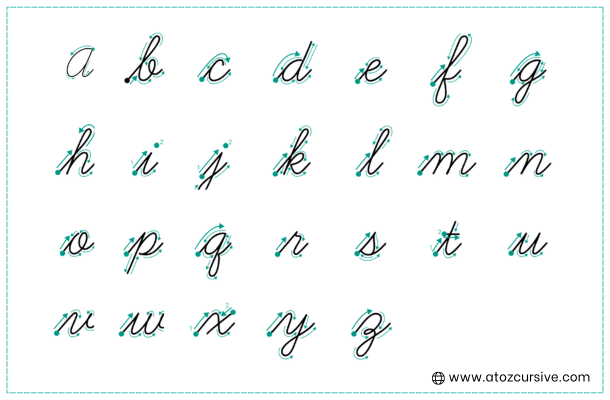
Lowercase letters are used most often, so it’s best to begin here. Practice each letter slowly and carefully. Learning lowercase cursive letters like a, c, e, l, n, and m is great for starting. Focus on the proper strokes and shapes, and repeat until they feel natural. As you practice, begin connecting letters to form simple words. Keep your writing smooth and flowing.
3. Move on to Uppercase Letters
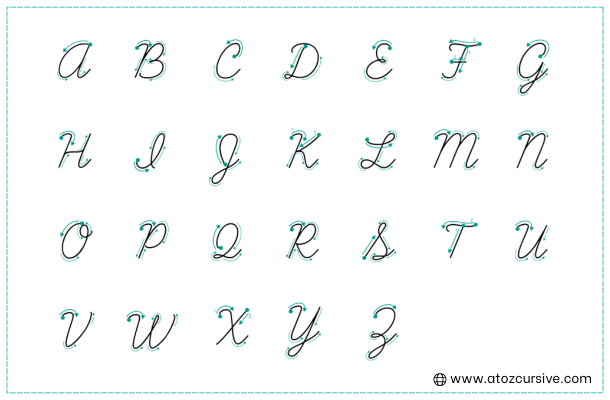
Once you’re comfortable with lowercase letters, learn uppercase letters. Some, like A or O, are just bigger versions of lowercase letters, while others, such as B, F, E, and L, have completely different shapes.
Remember that consecutive uppercase letters are usually not connected, but an uppercase letter can smoothly join with the lowercase letters that follow.
4. Connect Letters into Words and Sentences
The real magic of cursive is connecting letters to write words and sentences. Start with short, two-letter cursive words, then gradually try longer words and full sentences. Practice writing your name, favorite words, or phrases from books, songs, or movies. This helps your hand get used to the flowing motions and builds confidence.
5. Practice Regularly
Daily practice is key to improving your cursive. Spend 10 to 20 minutes each day writing letters, words, and sentences. Focus on speed, neatness, and consistency. Don’t worry if some letters feel tricky at first; you can adapt them slightly to make them easier while keeping your writing smooth. Over time, your cursive will become faster, more elegant, and enjoyable to write.
Tips to master cursive Writing
Mastering cursive takes patience, practice, and the right approach. Here are some simple tips to help you improve quickly and make your handwriting look smooth and elegant:
1. Practice Every Day
Consistency is key. Even 10–20 minutes a day can make a big difference. Start with letters, then move on to words and full sentences. Daily practice strengthens your hand muscles and improves control.
2. Use Cursive Worksheets
Practicing cursive worksheets, especially with a dotted middle line, helps keep your letters uniform in size and shape. This makes your cursive neat and balanced.
3. Focus on Letter Connections
Cursive is all about flowing letters. Practice joining letters smoothly. Start with simple words, then try longer words and phrases. The smoother the connections, the more elegant your writing will look.
4. Keep a Relaxed Grip
Hold your pen lightly at a 45-degree angle. A tight grip can make your hand stiff and slow you down. Relaxed fingers allow for smoother, faster strokes.
5. Slow Down at First
It’s tempting to rush, but speed comes later. Focus on forming each letter correctly before trying to write quickly. Accuracy beats speed when learning cursive.
6. Practice Common Words and Sentences
Use familiar words, your name, or favorite phrases for practice. Writing sentences that interest you keeps practice fun and helps you adapt your cursive to everyday use.
7. Mix It Up
Try different pen types like gel pens, fountain pens, or pencils. Experiment with different slants and styles to find what feels natural and looks best for you.
8. Be Patient and Keep Going
Some letters might be tricky at first, and that’s normal. Don’t get discouraged. With consistent practice, your hand will adapt, and your cursive will become fluid and beautiful.
Final Words
Cursive writing is a timeless skill that combines style, speed, and legibility. By learning how to write in cursive, practicing lowercase and uppercase cursive letters, and mastering smooth letter connections, you can transform your handwriting into a flowing, elegant script. Regular cursive practice cursive worksheets, focusing on letter joins, and maintaining a relaxed grip will help you write with confidence, clarity, and consistency.
Whether you’re writing letters, journaling, taking notes, or signing documents, cursive handwriting adds a personal touch and enhances your written communication. With patience, daily practice, and the right techniques, anyone can improve their cursive writing skills.
Start today, embrace the art of cursive, and enjoy the beauty of writing words that flow naturally across the page.