
- AtoZ Cursive
- Cursive D
Cursive D: Tutorial & Printable Worksheets (Uppercase + Lowercase)
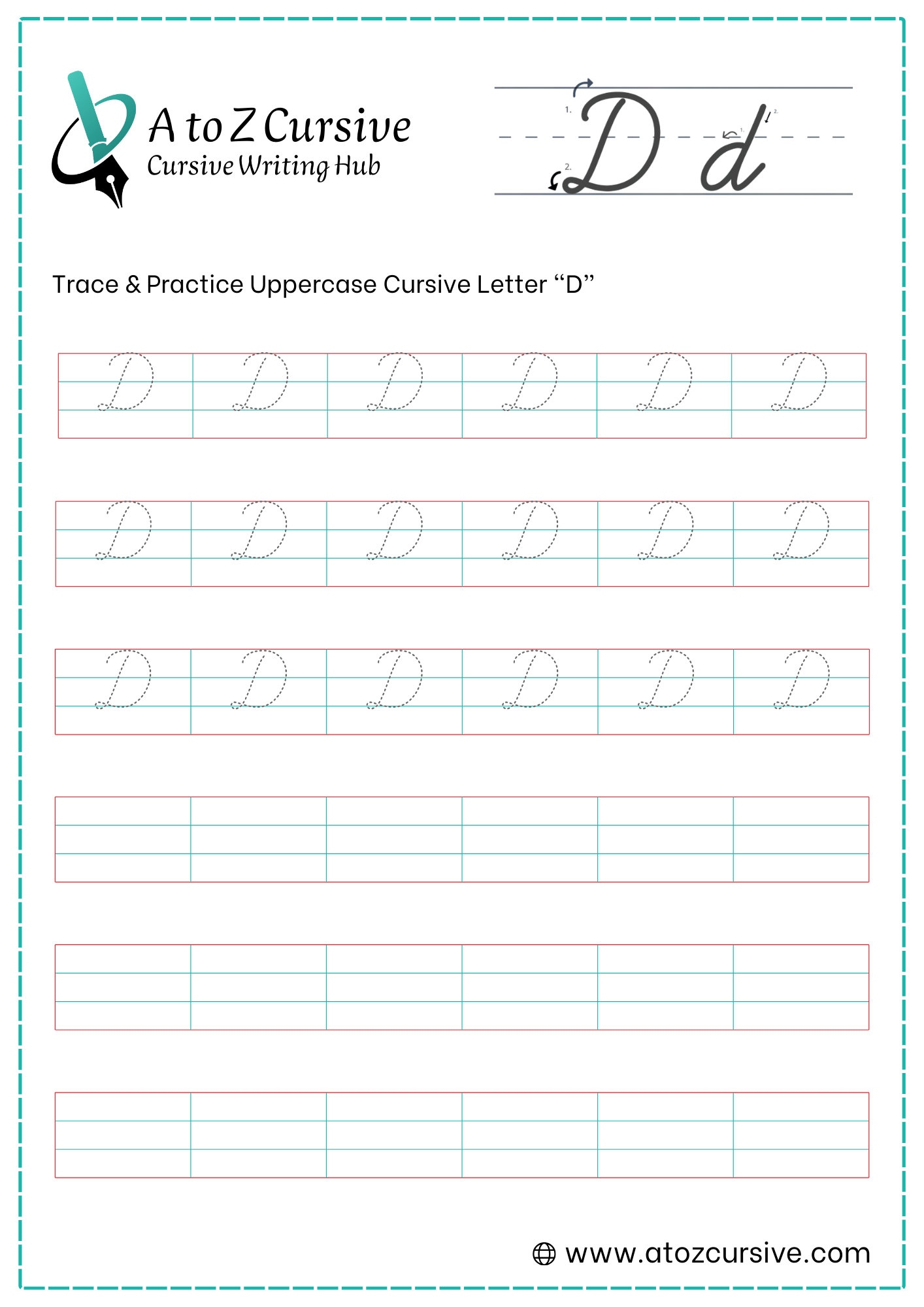
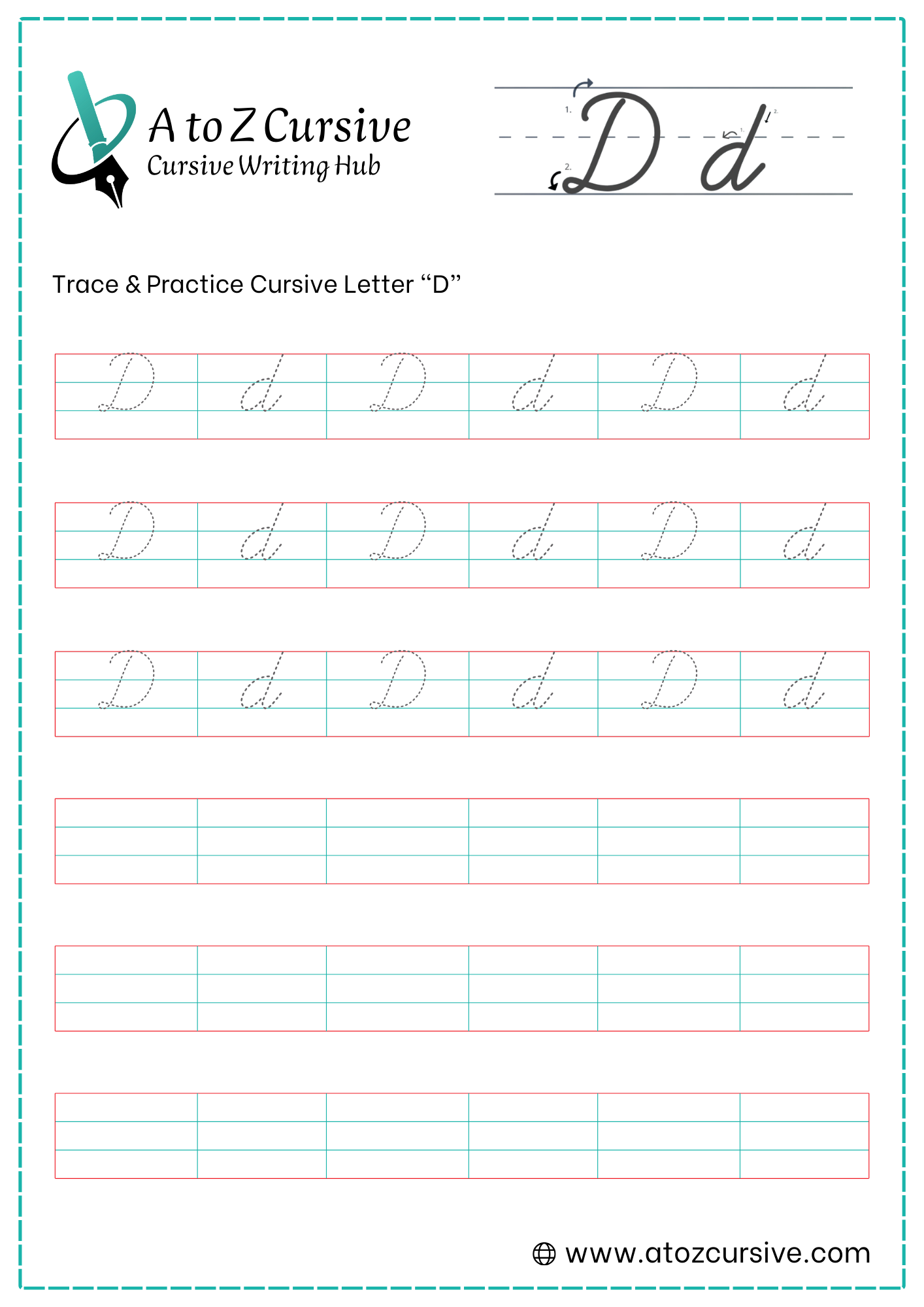
On this page, you’ll learn how to write the uppercase and lowercase cursive letter D using simple, clear steps. Also, download free printable cursive D worksheets for tracing, practice, and improving cursive handwriting skills.

How to Write D in Cursive
Writing D in cursive starts with smooth curves and flowing strokes. Follow the easy steps to form both uppercase and lowercase D neatly and confidently.
Lowercase Cursive D
-
Start at the bottom baseline. Draw a curved stroke up toward the midline, just like you are starting the letter "c" or "a."
-
Without lifting your pen, draw a straight line all the way to the top line.
-
Trace back down that same vertical line toward the baseline. This ensures the stem of the letter is crisp and straight.
-
As you reach the baseline, curve slightly back up and out to the right. This "flick" is the connector that allows you to join the d to the next letter.
Close the Loop: Make sure the "belly" of the d is fully closed before you go up for the stem so it doesn't look like a "cl" or an "ol."
Stay on the Line: Ensure the round part of the letter sits firmly on the baseline.
Uppercase Cursive D
-
Start at the top line and draw a straight or slightly slanted line down to the bottom baseline.
-
At the bottom, make a tiny, tight loop toward the left.
-
Curve the line out to the right, creating a large, rounded "belly" that touches the bottom baseline and swings back up toward the top.
-
Continue the curve all the way back to the top line, bringing it over the top of your original starting point.
-
End by curling the line inward toward the center of the letter (like a small spiral or hook).
Don't Lift Your Pen: The entire letter is one fluid movement.
The Loop Size: Keep the bottom-left loop small so it doesn't distract from the main shape of the letter.
No Connector: Unlike the lowercase d, the uppercase cursive D usually does not connect to the next letter in a word.
FAQs
To write a lowercase cursive D, start at the baseline, make a smooth upward curve to the midline, form a loop above, bring the stroke down, and finish with a small exit stroke. Practice cursive letters worksheets regularly for better accuracy.
Start at the top line, draw a downward stroke, create a small loop at the bottom, form a rounded curve out to the right, and finish with a connecting tail. Using uppercase D worksheets helps beginners practice smoothly.
Yes! You can download free printable cursive D worksheets for tracing, practice, and independent writing. These worksheets help learners master both uppercase and lowercase letters.
Finish each D with a small connecting tail or flick to the right. Practice linking lowercase or uppercase D with other letters using tracing worksheets for smooth, flowing handwriting.
Common mistakes include uneven loops, sharp angles, or disconnected strokes. Avoid these by tracing worksheets, following stroke order, and writing slowly at first.
D’Nealian cursive D has a modern, flowing style with rounded loops, while Zaner-Bloser cursive D is more traditional with distinct strokes. Both are correct and useful for learning handwriting.
With regular practice using worksheets, most students can master cursive D in a few days to a few weeks, depending on consistency and practice frequency.
Yes! Printable cursive D worksheets with proper guides help learners write faster and more neatly over time.
Cursive is usually introduced for 2nd or 3rd grade, but beginners of any age can learn with step-by-step worksheets and consistent practice.